André, the peasant

Between the two Provence workshops this year, my wife Anne, came over to France and we spent a week painting.

I had seen something during the first workshop that I wanted to come back to paint in early morning light. So I painted that and as I was finishing I noticed someone had stopped down the road next to Anne.

As I approached I saw Anne talking with an older man. He introduced himself as André. He was retired, he said, but had cared for the vineyards that surrounded us all his life. And the olives and apricots beyond.

He now lived in town, in Carpentras, but came each day to do a tour of his land. His son now cares for the grapes. André said: “Je suis paysan, pas agriculteur.” I am a peasant, not a farmer. I care for the land, not farm it.

Then he asked if I could paint the view for him. A view he said that was his favorite, that reminded him of his years of being here, that he could hang in his home since he now lived in town. As it happened I loved this view also. This very spot, I told him, I had photographed and used the photo as my promotional shot for the Provence workshops for years.

“How much,” he asked, “for a painting?”

I told him the price I would normally sell for an 8’ x 10” in the U.S., clearly in my mind more than he had for it, but I said since I loved this view also and since it was for him, 1 quoted a price about a fifth of my regular price. To that he agreed.

I went down the next morning and began around 8:30.

Because it was for André, a man who had lived and worked so intimately with this place I found myself unable to simplify as I normally would. It became like a family portrait. I felt I had to honor the custodian. Le Barroux, the village on the hill, I couldn’t just flatten into a simple blue shape. I found myself painting it. The hill behind the fields I painting in a red tree that I felt sure he must know. I painted the heavy rocks he had put on the roof of his abri, the toolshed, to protect the tiles from the harsh wind, the Mistral. I painted in the rusted metal cart beside the abri, which had been there for the five years I had been coming there. And I painted the foreground vines pulling me right down into (and probably out of) the bottom right of the painting. I had to paint André’s vines so he could see them properly.

I finished in a little less than two hours. It felt good working for a wage.

André arrived on his daily tour as I was packing up. I showed him. I could tell he loved it but he asked if I could change one thing.

With commissions this is always a sticky moment.

He wanted me to make the rusted metal wagon next to the abri smaller. André told us the story: when he first took over the fields from his father, he needed one of the metal wagons which they used for the prunings from the vines, so they could burn them safely in the field.

He advertised for one. Someone responded. They lived hours away but André decided he would take his truck and tow it home. Upon arriving he discovered the wagon had metal wheels and he couldn’t tow it so the seller suggested they cut the thing in two with a torch and he could load it on André’s truck so he could take it home. Which they did.

However when he arrived home both his father and uncle laughed at him because now cut in two it couldn’t function (for a reason I didn’t really understand since it looks like it was all in one piece) and so he dumped it next to the abri where it has stood since. Almost fifty years.

But it reminded him of one of his more foolish moments so I obliged him and cut it in half myself, but in paint.

I mounted the painting a few days later and delivered it to André’s son. Fortunately André was there himself. He took his painting, paid me, then took me to the small room where they sell their wine. He gave me a red, a rose and a white.

The rose I drank the next day at lunch with my landlord and his wife. The red and white are resting until May in the cave for when I return.
Watts Tower

I’d heard of Watts Towers decades ago. In Canada. Built by a four foot nine Italian out of salvaged junk in Watts, CA, it was a testament to something: inspired, if wacky, creativity; the power of perseverance (Simon Rodia worked on it alone for thirty seven years); grand outsider art. I’m not sure. But I had a chance to go and see it last week and did.

Watts Towers is now as much a monument to community as it is to creativity. At one point the city wanted it demolished. A group of writers, artists and filmmakers banded together to keep it alive. As if somehow it symbolized the spirit of art in man and so had to be saved.

Now Watts Towers is a park with an art gallery, art workshop space, amphitheatre and public grass (Watts looks more like Tijuana than LA, so the grass stands out).

It’s hard to take a photo of the towers that gives a sense of the whole or of their scale. A very heavy tall fence now surrounds it. The tallest tower, ten stories, made of rebar, wire and concrete looks perfectly true from a distance.  Rodia used no scaffolding. Any ladders he used he created within, and as part of, the structure as he went.

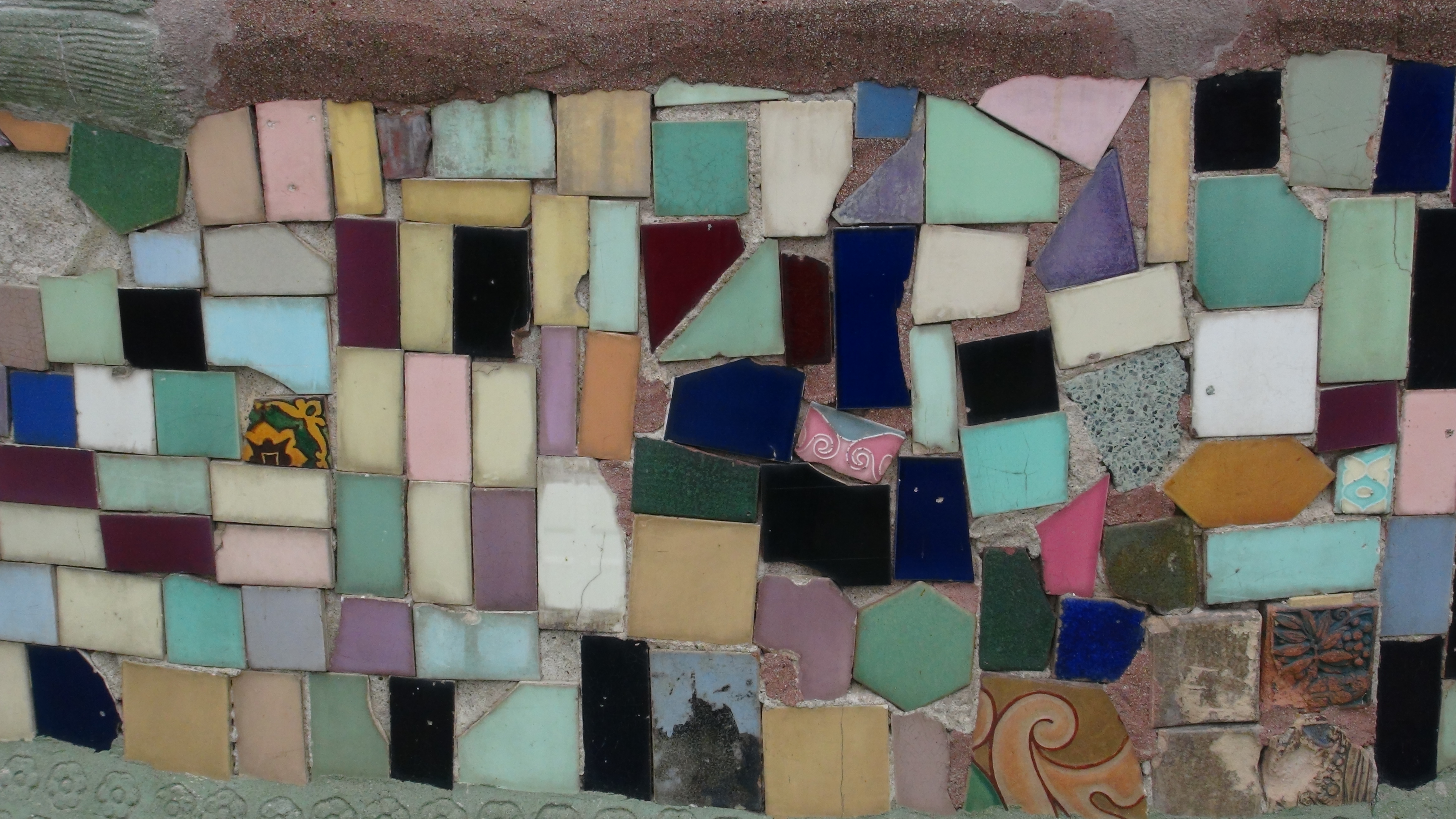
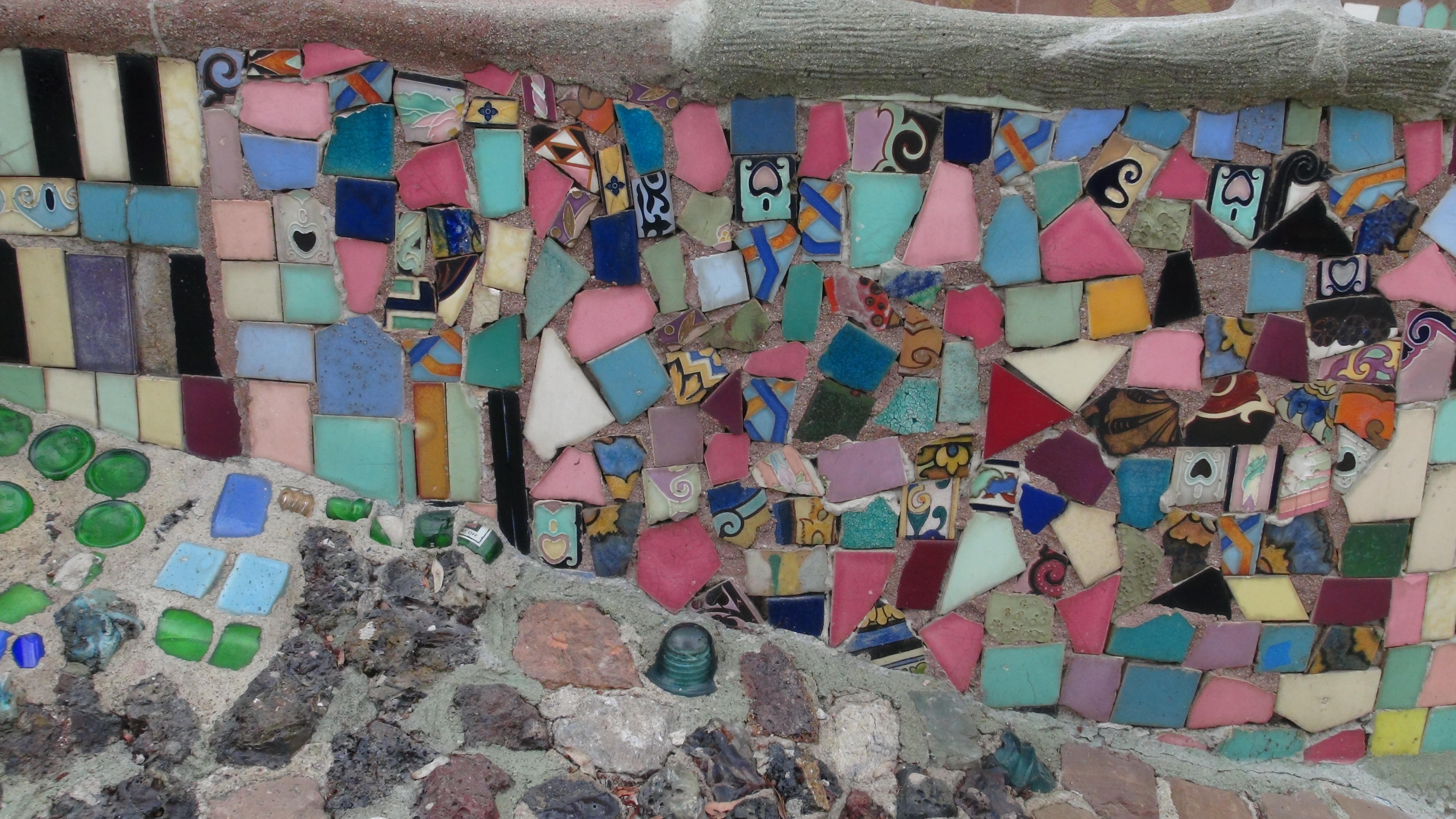
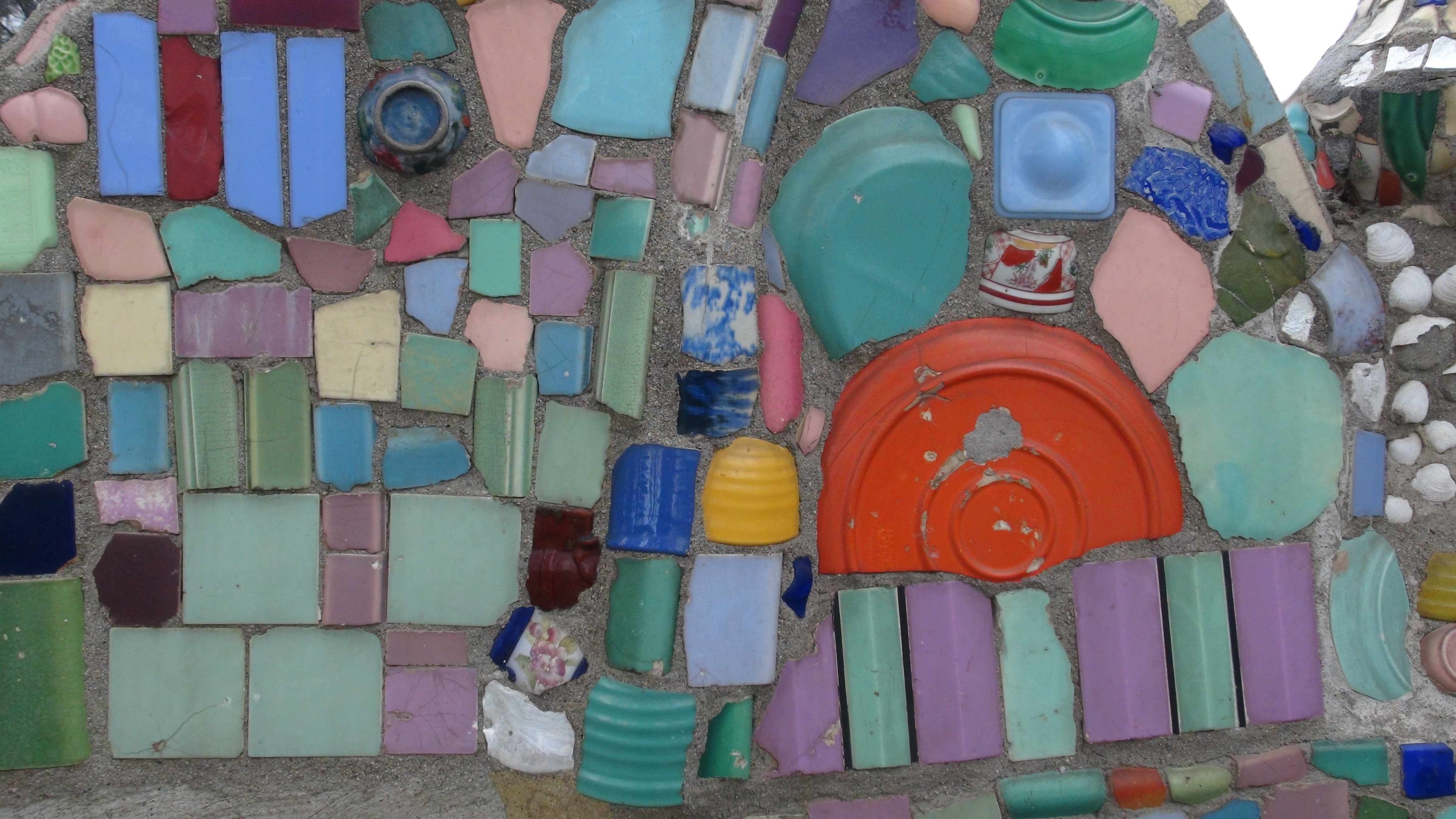
Kids pour through on guided tours. Which is how I got there. The best, and really only, way to give a sense of the exuberant creativity is in the tile work. Embedded bottle glass, tiles, shells, broken plates, concrete reliefs, junk, stuff. It is everywhere. It covers everything.

The property is a large triangle, the house at the front and the backyard, which is where he built the towers, tapers back to a point, which faces east. There he built a tile encrusted fanciful concrete boat heading east, back to his home in Italy.

In a sense the most astonishing fact about the whole enterprise — Rodia finished after thirty seven years, walked next door, handed the keys to his house to his neighbor, and left.

But he didn’t go back to Italy. He relocated near his sister somewhere else in California. And never went back to Watts.

I’d heard of this wacky creative wonder decades ago in Canada. Everyone’s heard of it. Everyone in Los Angeles has heard of it. Everyone wants to go and see it. But I haven’t met anyone else that has seen it. I’m not even sure I’d recommend going. Except you do see what someone, with no resources, can do, can create, with their bare hands, over time.

Then that stops you, or stopped me. What can I do? With the time I have left. What wellspring of boundless creativity will I tap into?

A poem we read at our wedding

I want both of us
To start talking about this great love
As if you, I, and the Sun were all married
And living in a small room.

Helping each other to cook
Do the wash
Weave and sew,
Care for our beautiful
Children.

We all leave each morning
To labor on the earth’s field.
No one does not lift a great pack.

I want both of us to start singing like two
Travelling minstrels
About this extraordinary existence
We share,

As if
You, I, and God were all married
And living in
A tiny
room.

—Hafiz

Ocean Park

Yesterday I went to the Orange County Museum of Art to see the exhibit of Richard Diebenkorn’s Ocean Park Series. I went with two painter friends and a non-painter. The non-painter felt he was in good company with three potential docents.

I have seen several Ocean Park paintings in museums over the years. Large, quiet, I always welcomed them, often being surrounded by other work I found either less accessible or incomprehensible.

So I looked forward to seeing rooms of this series. And there were rooms of them. Three or four paintings seven feet by eight feet in each room. Strangely as I went through the exhibit I felt little real connection. I did not feel much real presence from them.

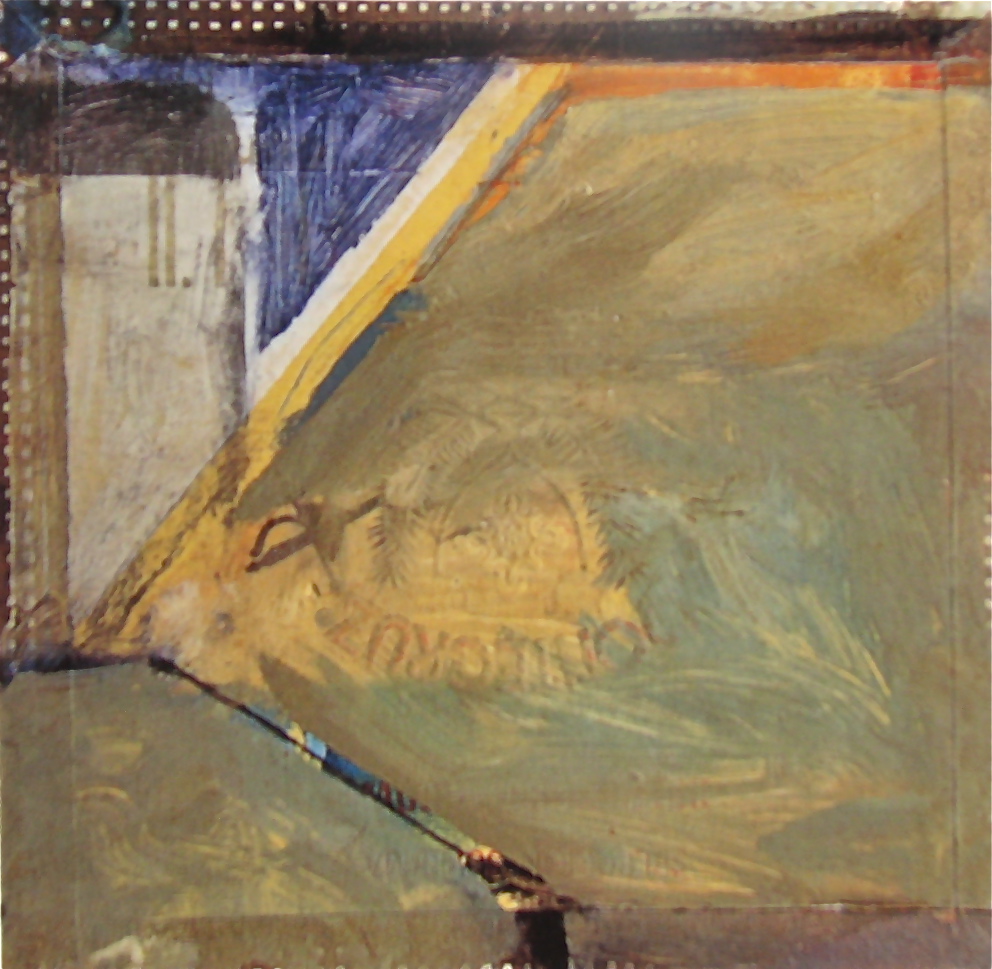
In the fourth room along one wall were mounted eight small ocean park pieces done on cigar box lids. They were pieces Diebenkorn had done for friends as gifts and never intended for sale (or perhaps for public viewing).

These small pieces had the juice. They sung; they enveloped; they lured me in and held me.

The one I liked most — five inches by five inches. It was my favorite piece in the entire exhibit (The reproduction here does not do it justice). My second favorite in the entire show was five inches by six inches, two down from it.

Interestingly as I communed with my favorite little painting, the non-painting friend came up and had exactly the same response to it.

I had always loved Diebenkorn’s work. But I realized most of what I had admired of the Ocean Park series was in reproduction. In a book both the five inch by five inch and the eighty inches by a hundred inches are about the same size on the page. The design and density of the large paintings actually looked better in reproduction.

As twentieth century printing became cheaper and more accessible art history went from people viewing originals to viewing pages of paintings, sculptures, alters, tapestries, architecture, all basically the same size, which radically abstracted the work and our relationship to it.

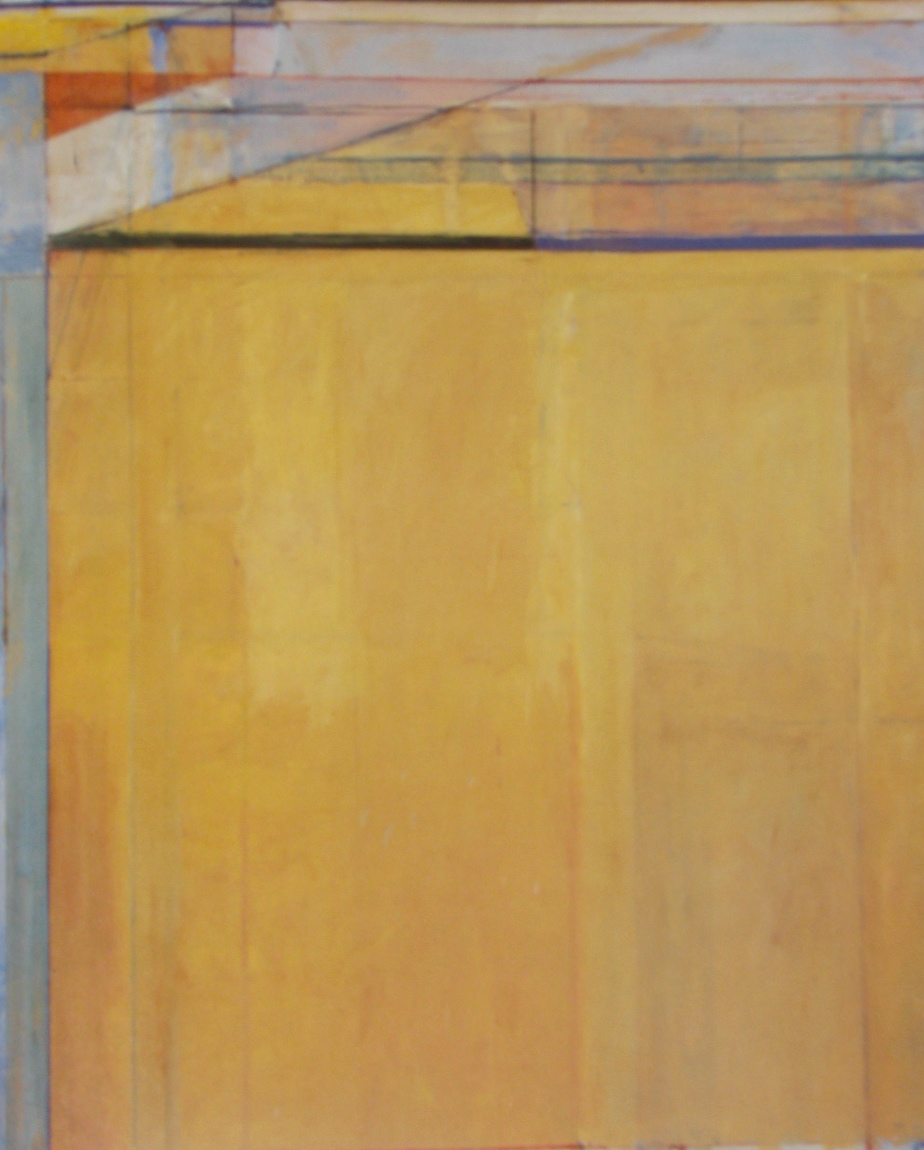
I recommitted to experiencing the large paintings. As I stood before these huge quiet pieces I realized I had an almost intellectual, not  painterly, satisfaction from them. There was beauty in how Diebenkorn articulated the space of the canvas. With horizontals, with verticals, with a few diagonals, repainting and repainting them. He found a way to tackle abstraction, of how to fill this space with such a quiet elegant simplicity. His insight of dividing and orchestration the space so simply created a body of work that defines a kind of abstraction. No one else can do what he did without it pretty much being a knock-off. Ocean Park becomes archetypal in that way.

As I stood in front of them and realized this, it warmed me. They were happy paintings. I wanted to like and admire the paintings. I like Diebenkorn.

But the take home lesson was clearly beauty does not need scale to hold us tight in her arms.

The Most Beautiful Thing

This clip from the film American Beauty touches on some fundamental ideas about beauty.

One, we can find it, if we are open, in the most unexpected places.

Two, we need to be open, simple and vulnerable to see it. Beauty is a communion.

Three, the experience of beauty can connect us to the deepest aspects of being, of the divine. That connection is like a memory of something dear but lost in the hurly burly of life.

Four, contained in that experience is also the mystical perception that everything is just as it should be.

Five, the vulnerability is attractive. I don’t mean in a romantic sense but in the sense of community.

This little three-minute clip contains a lot. It takes the first thirty seconds to set the stage. Then tell me if you too don’t see a moment of real magic as a plastic bag floats and dances in the breeze.

Patina

I live in LA. The city of the new, the shiny and the detailed (or young, hip and botoxed, depending if you are talking inanimate or animate). Here, older is suspect.

But time ages stuff. Grinds it relentlessly. Some things age well. Others poorly.

Most high-tech stuff, TVs, computers, iphones, doesn’t age well, mainly because it breaks or is obsolete before it really becomes an issue. 

Think of something that does age well. Say a wooden axe handle. Use enhances it. The oil, sweat and friction of a hand sliding on wood ten thousand times enriches it. The Japanese have a name for that — wabi sabi. The word contains a sacred quality. It is the beauty of the humble and worn. Wear creates the patina of life. What life is doing to everything everywhere all the time. We can fight it. We can buy new stuff relentlessly. A consumer society doesn’t tend to produce stuff that ages well. By definition. Its motto is dump and replace. 

Or we can embrace patina. Find beauty in it. 

What a wildly different relationship we would have to our stuff and how different our economy would function if the beautiful wear and texture of time were valued rather than abhorred.

ImageImageImageImageImage


Horizontal time—vertical time

I realized later in the week that Chronos, incremental linear time, was horizontal. It connected one moment to the next in an endless string of events. Kiaros, that moment that opens to the present in a suspended state of wonder or being, that is vertical time.

 We live in chronos obviously most of the time. Our entertainment and news is chopped into smaller and smaller pieces because it appears no one, although in fact I doubt this is actually true, has time for more. A bite size piece of news can’t contain real content. You can’t have discourse without content. What you get instead is reaction and outrage.

 Kairos, vertical time, is mystical time. A moment held by the song of a bird connects us to that.  We can go deeper. And deeper. Kairos embraces all, gives us our spiritual compass and our awareness of the sacred. And like a dive in a pool we get wet whether the dive is deep or shallow.

 This is where we find beauty. In mystical time. What seems so perplexing to me as an artist is giving expression to it. Technique and craft are like chronos. Linear, mundane, necessary. Kairos is like the vertical juice of life disgorged on the page. They do coexist and compliment each other. It’s creating the flow of them both, at the same time,  that is the trick.

Real Time

Appreciating beauty is a matter of attention. The quality of our attention is largely determined by time.

 The Greeks realized this and had two words for time. One was chronos, from where we get the words chronometer and chronic. This is the time of appointments, schedules, and calendars.  Ordinary time, passing time, forty-hour workweek time, run out of time. Quantitative time.

 Then there is kairos. This is qualitative time. Special time. Now. That moment where we break out of chronos into a moment of truth, of wonder, of being.

 The grim reaper is a symbol of chronos. While kairos represents life.

 We can only do so much to live in kairos. Just think of the books that tell us to be here now or that exhort the one hundred things we must do or see before we die. If the journey happens in chronos time we will arrive frustrated, exhausted, and late — obviously missing the point of the trip. While a moment of kairos could happen, now.

 Kairos keeps her own schedule. The American poet Randell Jarrell describes it:

“A good poet is someone who manages, in a lifetime of standing out in thunderstorms, to be struck by lightening five or six times.”

 Jarrell implies the poet is living open to, if not actually in, kairos.  His life is lived with antennas raised, poised and willing. He may be touched by kairos daily living like this.

 But in this quote he means being hit by the experience so hard that even after translating it into words he felt the experience still came through. He was talking more about giving expression to kairos, not just experiencing it.

 The great art historian Kenneth Clark once said you could take the work of any artist and destroy all of it except the three or four best works and their reputation would stand on the foundation of those three or four pieces. The three or four pieces when lightening struck.

 It raises an interesting point about one person shows of thirty paintings year after year. How often does kairos affect all that work? How do we open ourselves to karios and so affect our work, staying steeped in the poetics of thought, awaiting the aesthetics of wonder. For this is where beauty resides.

 I love the short Japanese poem form of haiku, which attempts to capture the moment of kairos.                     

lighting the woodstove

he kneels absorbed

in last year’s newspaper

            —Dee Evetts


            Winter beach

            a piece of driftwood

            charred at one end

            —John Stevenson


            After the snowfall…

            deep in the pine forest

            the sound of an axe

            —   sorry don’t know who this is by.

 A good haiku cuts us into that moment. We’ve all had them, that expanded moment of connection and being. Here I think lies the foundation of beauty, and wonder, and mystery. And the foundation of art that is meaningful.

The Road to Mecca


A couple of weeks ago, Anne, my wife, and I went to Indian Wells for a day at the tennis tournament. We intended to spend one night and come back to LA the next day.  But no hotel was available for just Saturday night in Indian Wells.

 So I pulled back on the map to see what other towns might be close by and might have a room. And then I noticed it. Mecca. By the Salton Sea.

 Mecca. Now that conjures up images and associations. Ideas of pilgrimage and arrival, of, if you’re Muslim, a life-long aspiration and calling of a place divine held lively in our imperfect world.

 I had visions of a town that would speak to distant beauty and perhaps even an interview or two of what it was like to live in Mecca. Surely a town could not have a name like that and not live up to some sort of mystical expectation.

 I said to Anne, we had to go and see it.

 Always game for a pilgrimage/wild goose chase herself, we went the next day.

 Driving from Indian Wells, Palm Desert towards Mecca one thing is immediately obvious. As the income level drops in a desert so does the green. The lush implausible lawns and verdant gated enclosures faded to the scorched grey-ochre of the desert as we moved east.

 I had done a little research on Mecca in advance of going. It’s population is 99% Indian and Hispanic. Of towns over five thousand Mecca has the lowest level of education of any town in the U.S.

 So I wasn’t expecting an oasis, a garden spot. No, I was hoping for something castoff and hard-scrabble.  A modest little town beaten by the harsh weather and the economy to a patina rich in honest beauty.

 Mecca is not that town. If you were on an outing and looking for some place with a little tree-lined main street and shops catering to idle purchases and cafes with cappuccinos, and cute homes with trim lawns and flower beds, Mecca would be a shock.

 However I was arriving with a different sensibility to what might be Mecca’s beauty. Open minded, generous, looking for ramshackle and broken.

 I fared no better.  I suppose I was shocked less than someone arriving expecting the quaint, the trim and the tidy. Nevertheless  I  too was blinded by my expectation and promise of that name, Mecca.

 Mecca, California, was a disappointment. I can’t say it doesn’t exist exactly. But the town was non-descript, featureless, barren even of eccentricities. I’m sure there are plenty. But the chances of an outsider considering looking for them seem remote.

 I managed one photo of Mecca that caught something of the place. Someone using a payphone in front of a 99 cent store.

Image

 So we left.

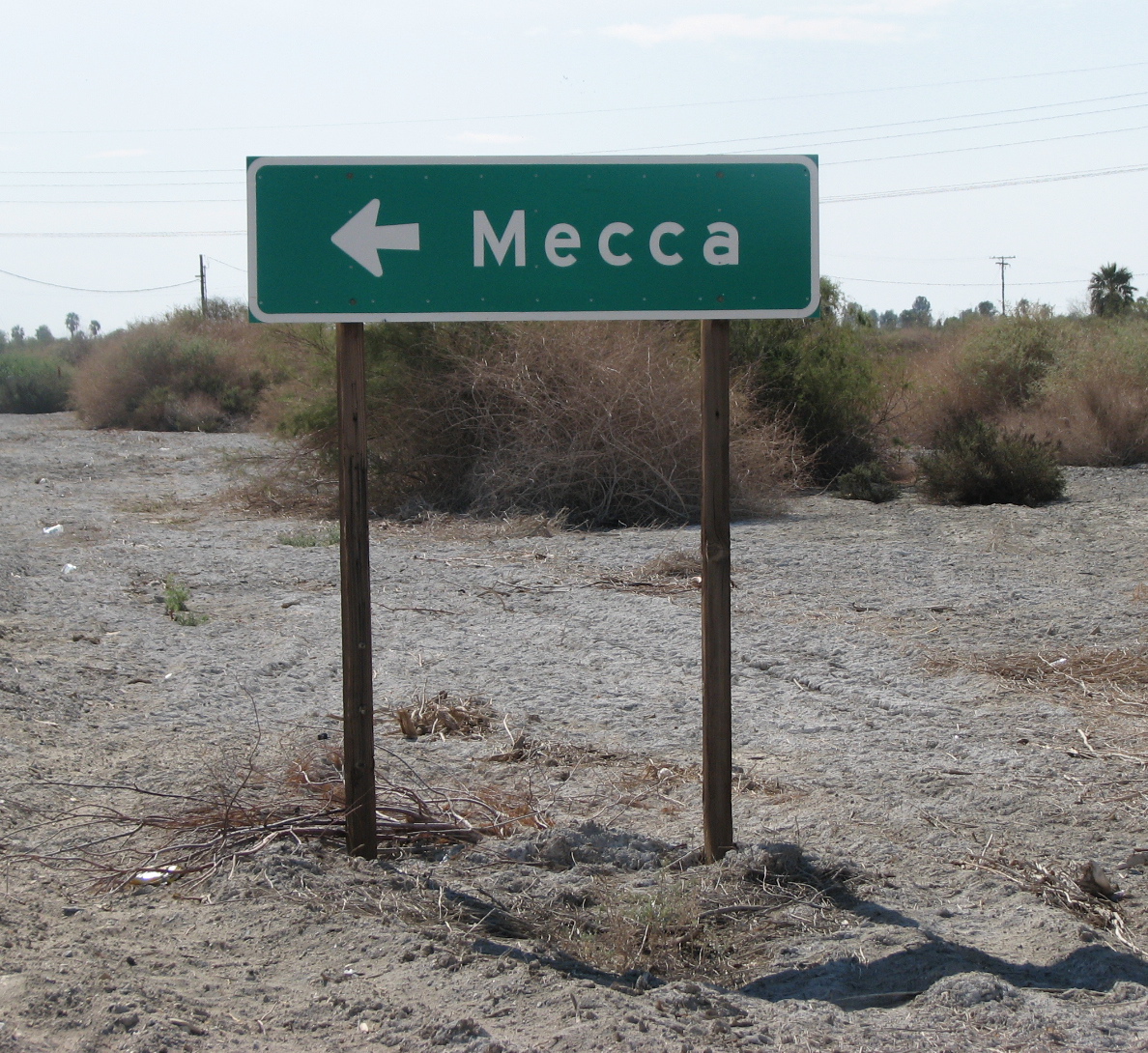
 Anne noticed this sign that really summed it up. Mecca is always some distance away. A place of longing and future arrival. Coming to terms with where you are now today requires more exacting skills.

Image

 Since we were at the Salton Sea we decided to have a look.

 For some reason I thought the Salton Sea would be like the Bonneville Salt Flats. Dry.

 But lo, the Salton Sea is huge, and wet. A real lake. The largest in California.

 We drove to a state park, learnt from a video how it was formed.  I won’t go into that here but it was created by man. By accident.

 The water is saltier than the ocean and getting saltier all the time. So the only fish that now survive in it are tilapia.  Millions of them. And hundreds of thousands rot on the shore.

 Disgusting and foul as it was I loved the dark green slimy water and the dark eyes against the white of the rotting corpses. It challenged my sense of beauty. Formally, meaning the image removed from the meaning or narrative (of dead fish), it was fascinating. Add the narrative and something appalling happens. Something apocalyptic. Which raises the idea of the sublime. A vision that sets us fearful and in awe before nature.

Image

Accidental Abstraction

Accidental Abstraction

This blog studies beauty. Like anything when you put your attention on something it grows stronger. So my attention gets caught now by pavement cracks, and those markings gas and water people spray on the asphalt, and the patina of old paint and right now more than anything the first few pink and green buds and leaves expanding out of the bark of the Honeycrisp apple tree we planted last month.

I’m not entirely sure the photos that follow are necessarily beautiful. That may be beside the point. But they are interesting, to me. They are examples of things that surround us. Curious and unusual stuff. And I suspect the finding of beauty is being open to it. All of it.

On of the central ideas here I think is the difference between the two Greek words for time. One is chronos. That is second after second, minute after minute, hour after hour, day after day time. The time that rushes by. The one where we find ourselves late, rushed, behind.

The other Greek work for time is Karios. That time where everything stops, there is silence, being, now and nothing else. That is the time of beauty. Because it flows into us then, into our being. Or we discover that is what we are.

In the next few days I want to write more on these two words and how perhaps they influence our perception of beauty, and ourselves.